Feeding your baby in the first few weeks
Feeding your baby in the first few weeks can be very rewarding but this may also be a stressful time
Position and attachment
Make sure you get yourself into a comfortable position first. Then understand the way your baby attaches to the breast, are key to ensuring your baby is able to most effectively remove milk and that the feed is not painful for you.
La Leche League GB has useful information about feeding positions, including videos.
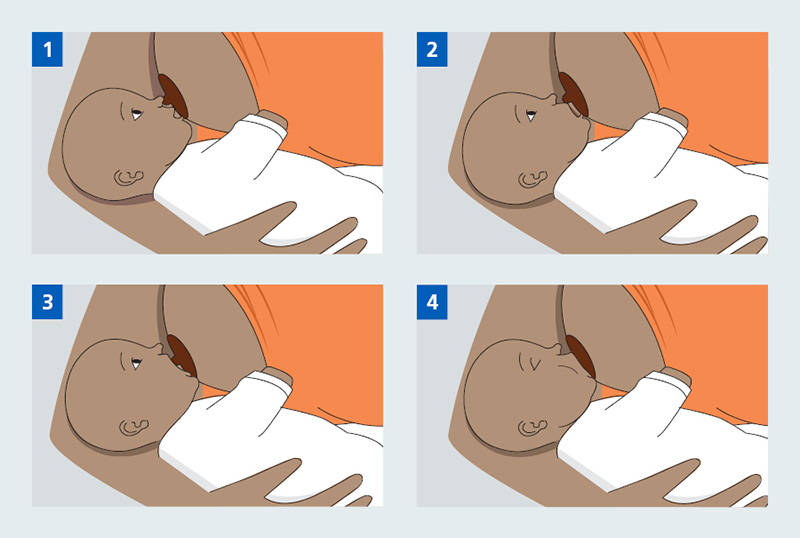
How to tell that your baby is attached properly
- Nose opposite nipple (sniffing), bottom lip near the edge of the areola
- Wait for your baby to have a wide, open mouth
- Bring your baby in close, with the lower lip near the bottom of the areola, and the nipple sweeping under the top gum.
- Your baby is attached!
- Chin indenting the breast
- Nose clear
- More areola visible at the top of the breast
- Wide open mouth
- Full cheeks
- Rhythmic suck-swallow pattern
- Baby is settled
- Bottom lip curled down (If you can see it)
Things to remember about breastfeeding
When breastfeeding, it can feel worrying if you are unsure if your baby is getting enough milk, particularly if they are unsettled or feeding frequently.
It is important to remember; most babies lose some weight in the first few days before starting to regain.
A good indicator of milk intake is the number of wet and dirty nappies.
In the first 48 hours, you can expect 2 to 3 wet nappies, increasing to at least 6 by day 6. Stools (poo) will change from a thick black tar-like substance called meconium, to lighter, yellow stools by day 5 to 6, with at least 2 poos daily.
If your baby is following this pattern, they are likely to be getting enough milk.
After 4 to 6 weeks, breastfeeding becomes more established. Some babies may go a few days or more without pooing. Constipation is rare in a breastfed baby, so when they do pass a poo, it should still be soft and yellow.
If you are at all worried, speak with your midwife or health visitor for reassurance.
What baby poo looks like
Your baby's first poo is called meconium. This is sticky and greenish-black. Some babies may do this kind of poo during or after birth, or some time in the first 48 hours.
After a few days the poo will change to a yellow or mustard colour. Breastfed babies' poo is runny and doesn't smell. Formula-fed babies' poo is firmer, darker brown and more smelly.
Some infant formulas can also make your baby's poo dark green. If you change from breast to formula feeding, you'll find your baby's poos become darker and more paste-like.
If you have a girl, you may see a white discharge on her nappy for a few days after birth.
It's caused by hormones that have crossed the placenta to your baby, but these will soon disappear from her system.
These hormones can occasionally cause slight bleeding like a mini period, but in both cases it's nothing to worry about.
Responsive and paced bottle feeding
If you’ve chosen to bottle feed your baby, you might be concerned about selecting the right formula, the necessary equipment, and learning how to feed your baby as you navigate this new experience.
Here are several helpful links to guide you through bottle feeding your baby:
Breastfeeding support in other languages
- La Leche League offers support to breastfeeding mums in a variety of languages
- Baby-Friendly Initiative offers a wide range of foreign languages
- The Best Start Resource Centre has resources on preconception health, prenatal health, and early childhood development in 26 languages. The ‘Breastfeeding Matters: An Important Guide’ is available in an extensive range of languages
- Other breastfeeding videos in different languages